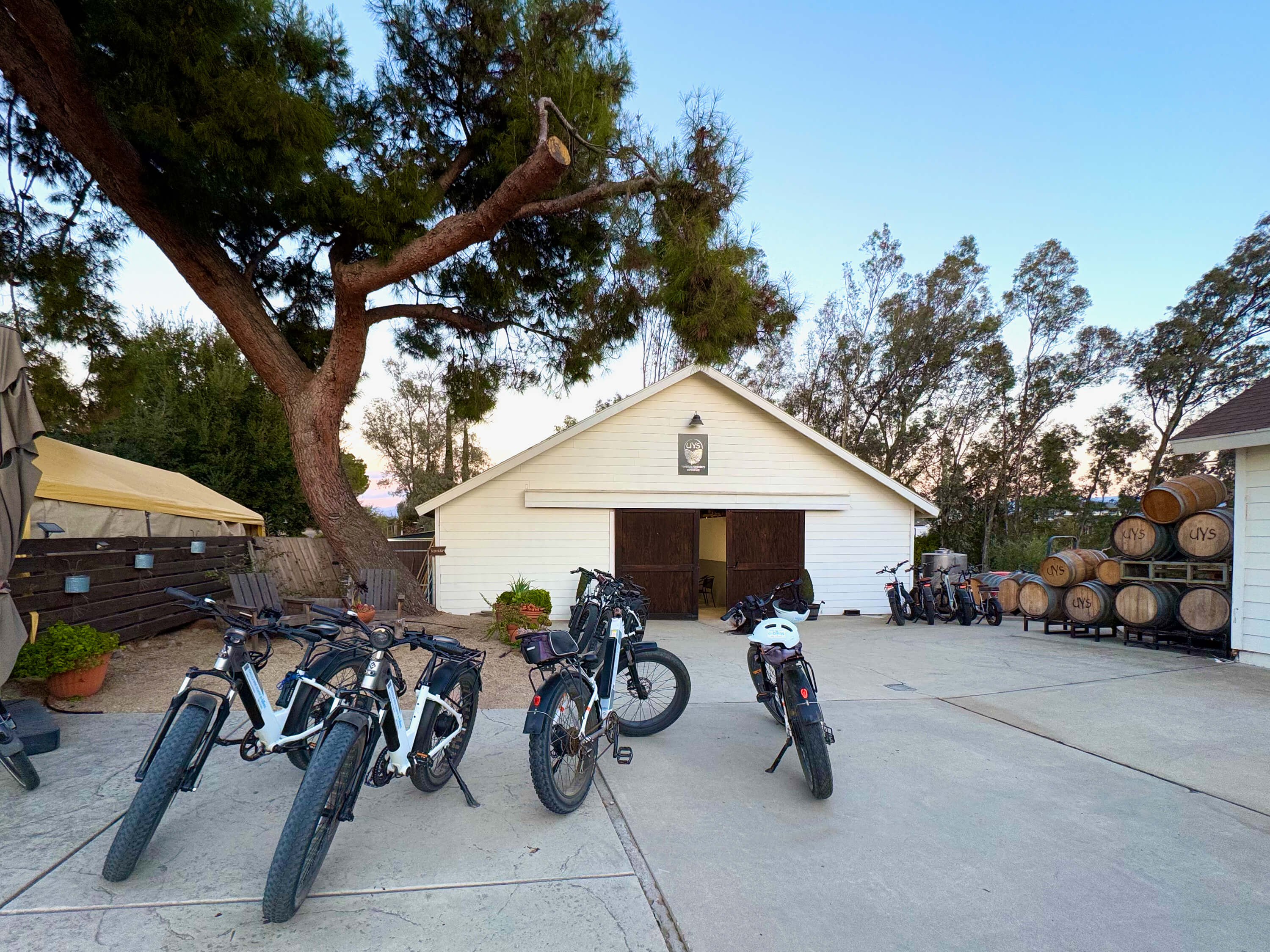
My husband Dan and I had just stepped out of our car when Dirk Uys (pronounced “ace”) of Uys Garagiste Winery and Temecula Wine Country e-Bikes stepped from behind a gate to greet us. Both businesses are run out of his house on a quiet road in Temecula Valley’s wine country, and we were just a short walk down his driveway. The winery practices organic farming methods and produces excellent natural wine. And, by “the winery,” I mean Dirk and his wife Michelle, owners and winemakers, who emigrated to the United States from South Africa in 2003.

Uys Garagiste Winery was born from a longing for a European style of wine that Dirk and Michelle couldn’t find in California. And so, finding the budding Temecula wine region an idyllic place to raise a family, they bought three acres of land in 2009 and planted one with grapevines. Three years later, the couple produced their first wine, 18 bottles of Syrah. With no formal training beyond an oenology class led by local winemaker Gus Vizgirda, Dirk has since experimented with many varieties—including Pinotage, his native South Africa’s signature grape—and won awards from the Orange County and San Diego County Fair Home Winemaker’s Competitions as well as from the WineMaker International Amateur Wine Competition. Today, they create single varietal wines and blends from Grenache, Sauvignon Blanc, Petit Sirah, Zinfandel, Barbera, and Cabernet Sauvignon, among others—from vines mostly grown within two miles of their house. Their Riesling and Zinfandel come from a friend’s vineyard in nearby Anza.
Garagiste
A movement that started in Bordeaux by a group of farmers who didn’t want to be forced to follow the strict guidelines the French government demanded of traditional winemakers. Today, it refers to small-batch winemaking.
Dirk and Michelle wear the label “garagiste” proudly. They make small batch wine; once they run out, they’re out and are on to the next. The phrase “Pursuing the soul of wine” is embossed on their wine glasses and printed on bottles. It’s a line inspired by Clark Smith’s book “Postmodern Winemaking: Rethinking the Modern Science of an Ancient Craft” written in reaction to the mass production winemaking methods seen at large producers. They have no full-time employees. It is a true husband and wife operation, soliciting volunteers in years past to help with the harvest. Browsing through their social media, you’ll come across photos of Dirk high up on a ladder hanging a sign for the winery or putting up barn doors and Michelle wrangling boxes of wine bottles and trimming bunches of grapes from vines. A mechanical engineer by trade, Dirk cares for the equipment around the production room and maintains the e-bikes for the other half of their business.

Our Experience at Uys
Uys offers two tasting options: A seated tasting or a tour of the grounds with a wine tasting at the conclusion. We had booked the seated tasting, so Dirk led us directly to a small-ish barn, which also serves as the production facility and barrel room. A large farm table had been set with wine glasses, glass bottles filled with water, and tall Birds of Paradise in a vase. Our tasting companions, a friendly family of five from Cincinnati, were already seated inside. Fans of natural wine, they had visited Uys the year before and made it a point to book a return visit for this year’s trip to Temecula. Dirk had purchased a couple of different “palate cleanser” savory shortbread cookies that he poured into little bowls for us to sample and tell him which ones we thought he should order in bulk for future guests. And so our tasting began.

After describing their minimal intervention winemaking methods, which he practices in the vines and the production room, Dirk started pouring. The Uys menu states that a tasting consists of “5 wines of your choice,” but with our small group, Dirk must have sensed that he had a good audience and told us we’d be trying each of the 10 wines listed on the menu. In South Africa, he explained, it’s customary to make liberal use of the spit bucket rather than finishing each pour to be able to try more wines. Then they’d order a glass of a favorite wine once the tasting had concluded—a hint that we should do the same and a great host trick to ensure we got home safely.

I’m not experienced in the world of natural, unfiltered wines, and they certainly have a mixed reputation, so I didn’t know what to expect. But I was bought in after our first pour, a side-by-side tasting of two Grenache Blancs from the same year. One had been aged in stainless steel, the other partially in neutral oak. While both were subtle, with flavors of stone and tropical fruit, they had distinct differences on the finish. Dan and I liked both styles, preferring the crisp stainless steel version, while others at the table appreciated the nutty qualities that the oak added. There were more wines to compare: two vintages of Sauvignon Blanc and two different years of his Cotes du Rancho, blends of Mourvèdre, Grenache, and Syrah that he was avoiding calling GSM because neither matched the typical profile. The earlier year was more Mourvèdre forward, the latter more Grenache. We also loved the Merus, a blend of Cabernet Sauvignon and Petit Sirah that was big and full of blueberry and raspberry.

One of the most interesting wines was the 2023 Pet Nat Riesling. A semi-sparkling wine, Pet Nat (or Pétillant Naturel) is bottled before fermentation has ended, naturally rendering it softly fizzy rather than bursting with bubbles like a typical sparkling that has had sugar and yeast added to increase fermentation. I’ve read that some Pet Nats can be funky because the lees (the dead yeast) are not disgorged, but this one wasn’t. I found it light and citrusy, though it did become cloudy once opened due to the lees breaking apart. Dirk explained how this can be avoided at home by simply freezing the bottom of the bottle in an ice and salt bath, which keeps the lees frozen solid inside when pouring.

At the close of the tasting, the sun was setting, but everyone lingered at the table. Michelle stopped by to say hello and chat for a bit, asking which other wineries in the area we enjoy and to see if anyone in the group needed restaurant recommendations for dinner that night. Though clearly serious about their winemaking, the couple had created a warm, light-hearted atmosphere that lacked pretension. We were even jokingly chided for being quiet after tasting so many different wines—I think we were all just relaxed. They were off to play pickleball with friends down the road despite the chilly evening, so we eventually left them to their fun and headed home with bottles of the 2020 Zinfandel and the 2021 Grenache Blanc in tow.

Tastings at Uys are by appointment only. Guests can book a Garagiste Tasting for $30 per guest or a 90-minute Vineyard and Winery Tour for $55 per guest. Bottles were between $28 and $55, well-priced for the area. For out-of-town visitors, Domaine Chardonnay’s French chateau-style bed and breakfast and Rusy Fork Ranch are just down the road.
E-bikes are rentable for 4 or 8 hours. Guests renting bikes for the day (8 hours) can have the bikes delivered to them at most local hotels. All rentals come with a map of the area and personal recommendations from Dirk and Michelle. Optional carriers are available to rent to hold wine purchases, and a wine tasting at Uys can be added to any e-bike experience.